Ipinapakita ang mga post na may etiketa na Philippines. Ipakita ang lahat ng mga post

Sabado, Oktubre 6, 2018

中国花园 Chinese Garden in Manila, Philippines

   This Saturday morning I had the chance to visit the Chinese garden located in Rizal Park, in Manila. It was almost an hour drive from where I live to Manila. I came to discover the Chinese garden in Manila based on the post of my friends in Facebook. Actually, I was hesitant to go to Manila, since I know its going to be a long trip. But I pushed through because I know I won't be at ease if I didn't take the opportunity to go there. I really wanted to see the huge statue of Confucius and the Chinese style garden design of the place.

It was quarter to 9 in the morning when I arrived there. It was a bit hot, because the sun was shining. There is no entrance fee, you just need to log on the record book provided by the staff. Since its Saturday there are a lot of students, and families at the park. The Chinese garden was not that big and you can go around it in less than 5 to 10 minutes. I have read a lot of negative reviews online, but for me the garden is quite nice. Very Chinese. It feels like I'm in China. ha!ha!ha! Even if I know it can never be at par with the famous Suzhou garden in China. I immediately went to the statue of Confucius, and had my photo taken. It was quite huge, and there is a history plaque below the statue. Its about a short bio of Kong Fu Zi (Confucius). I have watched the movie of Chow Yun Fat who portrayed Confucius, and its a good movie. I also love the soundtrack. I also admire Confucius. I have a Chinese philosophy book, and the life of the great master Kong is included there.

Also, the last week of September is where the world, and the Chinese people commemorate the birthday of Confucius. According to Wikipedia, "Confucius birthday falls on the 27th day of the eight lunar month of the Chinese calendar. It is officially celebrated on Taiwan as 'Teachers Day' on September 28th, and in Hong Kong on the 3rd Sunday of September as 'Confucius Day', though the traditional date is also often observed. While in China, they observe the 'Teachers Day' on September 10."

Here in the Philippines, on the 28th of September 2018, His Excellency Ambassador Zhao Jianhua gave a speech at the Chinese garden at Rizal Park, Manila. Government officials were also present. According, to the speaker, the celebration honors teachers, and promotes Confucian values.

One of my favorite quotes by Confucius, which I shared in my story that was featured in a local Filipino-Chinese magazine goes something like this, "Never tire to study and to teach others."

If you have never been to the Chinese garden, and if you love taking a stroll at the park then you better visit Rizal Park, and the Chinese garden.

Sabado, Setyembre 8, 2018

The Ties That Bind by: Teresita Ang-See (Mini-book review)

   Last week my order of the mini-book, "The Ties That Bind" (The Saga of the Sultan of Sulu in China). This is the 2nd edition, written by well-known, and respected Filipino-Chinese writer, and academian. Known in the Philippine media press, as an anti-crime crusader. She is also also one of the founders (along with her late husband Prof.Chinben See) of Kaisa Para sa Kaunlaran, and Kaisa Heritage Center.

From tulay.ph: 

"The Ties that Bind – the Saga of the Sultan of Sulu in China (Kaisa Para Sa Kaunlaran, 2017, 109 pp.) uses references and resources from China and the Philippines – including valuable photographs – to document the historic visit of the Sultan of Sulu to pay tribute to the imperial court of Ming Emperor Yong Le in 1417. The booklet is published in commemoration of this most significant event which highlights the enduring friendship between the Philippines and China."

You can order online, and have it shipped to your place. Just follow the instructions of their staff. I also contacted them through their Facebook account, and Ms. Meah See, director now of Kaisa, and the daughter of the author was really accomodating. You can finish the book in one-sitting. The book is printed in glossy pages, and the photos are rich, with colorful pictures. As a supporter of the Philippines and China's positive and harmonious relationship,  and as a member of the Philippines - China friendship club. This mini-booklet is full of interesting facts, and details about the long-standing relationship, and friendship of the two countries. Did you know that the Sultan Padaka has living descendants up to now? They have also visited the Philippines.

The story of the Sultan of Sulu, and the Emperor of China was made into a movie wayback. The title was 'Hari sa hari, Lahi sa lahi,' the international English title was 'King and Emperor.'

If you are a Chinese culture enthusiast like me, or if you are interested in culture and history, you should definitely grab a copy of this book. I got my 2 copies for P140.00, plus additional shipping fee. I also requested for the book to be signed by the author. I have not met the author personally, but I'm looking forward for a chance in the near future.

Or you can visit Kaisa, located in Intramuros, Manila. They have a gift shop there when I visited them wayback. They sell t-shirts, and various educational books about Filipino-Chinese culture and history. You should also check out their museum also located in the same building. It is a museum of the Chinese in the Philippine life. It is a definitely must-see. I really enjoyed touring the museum before.

(Fast forward to year 2026, I finally met Ma'am Teresita Ang-See through my new doctor who is her sister.)

For orders and inquiries: 
You can contact them through their facebook page Kaisa Para sa Kaunlaran or you may email them at info@kaisa.org.ph 

Linggo, Hulyo 2, 2017

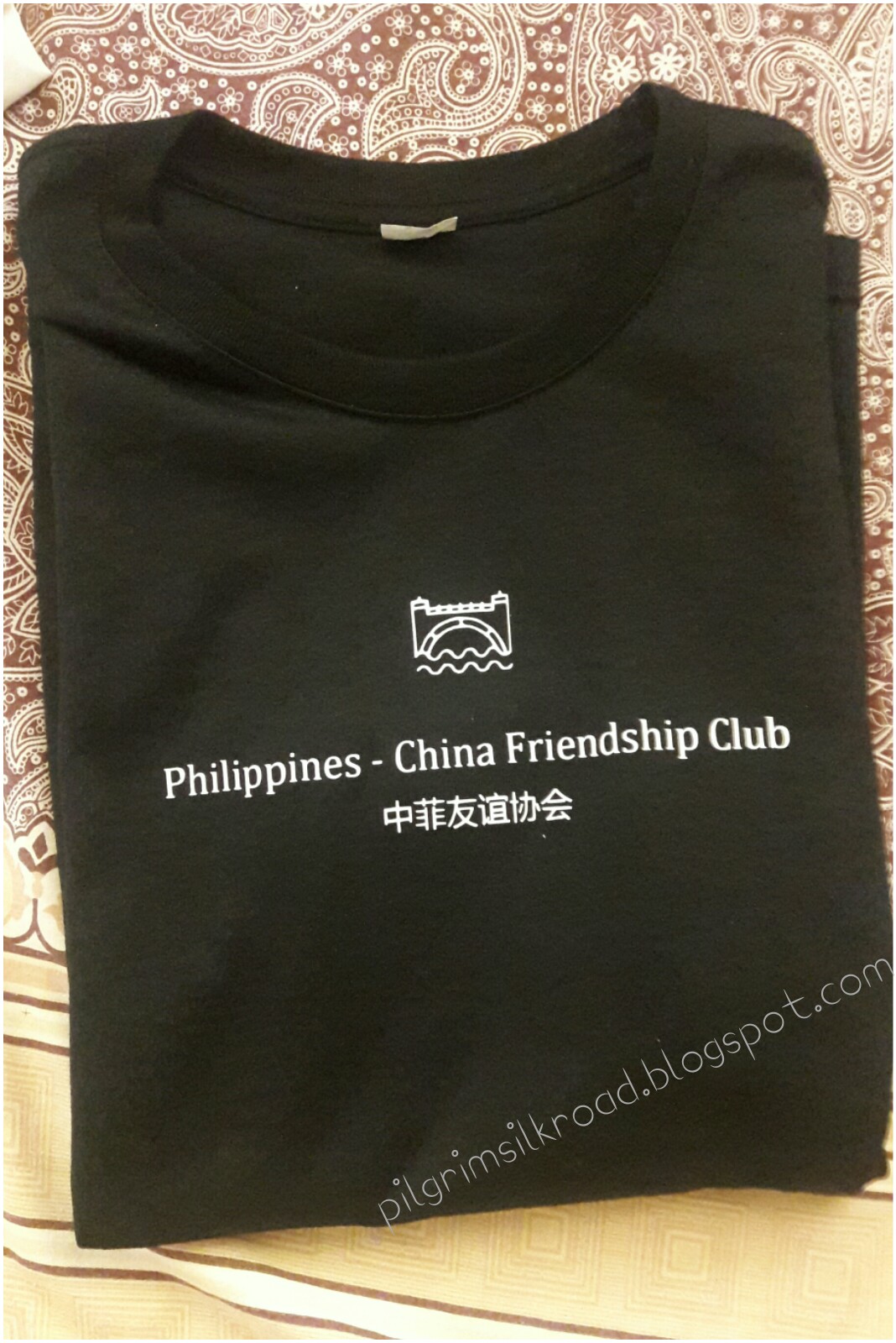
Philippines-China Friendship Club (PCFC)

  I badly wanted to join a Filipino-Chinese or any Chinese studies organization/association or club before. As a Chinese studies and culture enthusiast I wanted to be a part of a solid organization that can help me learn more about China, and wherein I can be considered as part of the family, with the same aspiration as mine. I thoroughly search online and was blessed enough to read about Philippines-China Friendship Club. I was fortunate enough to be able to get in touch with the founding president of that club, a young professional, Mr. Austin Ong. He's an alumnus of the University of the Philippines, and also a master's degree holder from Tsinghua University (China). He has been to a lot of countries, and has been guested in local tv shows here in the Philippines. I have met Sir Austin Ong personally at KAISA this year.

What is Philippines-China Friendship Club all about?

From PCFC website:

It is a friendship club that strives to provide platforms of interactions for Filipino students and young professionals to establish and cultivate life-long friendships with the Chinese.

Objectives of PCFC:
+ To build and to strengthen Filipinos and Chinese friendship through fun and meaningful events.
+ Be a resource for Filipinos to maximize their "China experience".

PCFC also holds meetings, and social gatherings with fellow and like-minded Chinese studies scholars, students, and professionals. (Check out the group photo here about an event that was held in the past, my graphic drawing was also used in the invitation and group page.) I'm also thankful to the founder of PCFC because 2 years ago, I was able to attend the inauguration of Confucius Institute in U.P Diliman. As a former student of Confucius Institute in Ateneo, that was another milestone in my life.

I believe that we can work together for the common good. I hope that the relationship of China and the Philippines will be even more stronger. The relationship of this 2 countries dates far back.

If you are interested in joining the group, you can search for it on Facebook.

(Update: This July 2018, we have available PCFC customized t-shirts. See the photos above. For orders just leave a message here. Thanks!)

Sabado, Marso 18, 2017

二胡 First Lesson in Erhu (Chinese 2 stringed-fiddle)

Today I had my first lesson in erhu. To play the erhu and own one is one of my Chinese dream. I bought my erhu for around P7000 (seven-thousand) Philippine Pesos. It is a bit expensive. But my teacher says that the price is alright. I bought my erhu from a local online seller whose husband is Filipino-Chinese. My plan originally was to enroll again at Confucius Institute, but this time in Makati because they don't offer the Chinese music course in Katipunan. So I tried looking for an erhu teacher online. I contacted a former student from U.P. Diliman who plays the violin, and is now based in Singapore. She suggested that I try contacting the Music department in U.P. Diliman, and look for Prof. Ongsiako. I searched for this person online, and I found out that they have a music group or ensemble. They perform usually in Chinese events and by request. (You can contact them in Facebook, just search for Kim Hwa Music Ensemble). I contacted them, and they arranged a lesson for me. My erhu teacher is the daughter of Prof. Ongsiako. Ms. Tanya is her name. According to her she has been playing the erhu, since she was 7 years old. She was a guest before in GNN tv show hosted by Mr. Herman Tiu Laurel, wherein she showed her musical prowess.


On to today's happening. My erhu was not yet playable, so the first thing that she did was that she assembled my erhu. She skillfully re-attached the strings to the pegs, and carefully wiped my bow with rosin. While doing that we chatted about my interest in Chinese culture, and I asked her a few questions with regards to the erhu (the price, and the quality of my erhu). She asked me if I have Chinese ancestry, I told her I don't know. I further added, I'm Chinese by heart (because I love the Chinese culture, no pun intended. I am serious about this). This blog proves how much I adore the Chinese culture.

Our first lesson is how to hold the erhu, and the bow properly. She said its similar to holding a chopsticks. I told her I'm not that very good in holding the chopsticks so I was having difficulty holding the bow. I did bow exercises, playing the inner and outer string. The erhu, although it sounds similar with the violin, they differ in many ways. The erhu is a 2 stringed instrument, and it has no visible frets. The bow is secured in place in the middle of the strings. I hope I can play even a simple piece someday.

Parts of the erhu (source: Wikipedia)

Qín tong (琴筒), sound box or resonator body; it is hexagonal (liu jiao, southern), octagonal (ba jiao, northern), or, less commonly, round.
Qín pí/She pí (琴皮/蛇皮), skin, made from python. The python skin gives the erhu its characteristic sound.
Qín gan (琴杆), neck.
Qín tou (琴頭), top or tip of neck, usually a simple curve with a piece of bone or plastic on top, but is sometimes elaborately carved with a dragon's head.
Qín zhou (琴軸). tuning pegs, traditional wooden, or metal machine gear pegs
Qiān jin (千斤), nut, made from string, or, less commonly, a metal hook
Nèi xián (内弦), inside or inner string, usually tuned to D4, nearest to player
Wai xián (外弦), outside or outer string, usually tuned to A4
Qín ma (琴碼), bridge, made from wood
Gong (弓), bow, has screw device to vary bow hair tension
Gong gan (弓杆), bow stick, made from bamboo
Gong máo (弓毛), bow hair, usually white horsehair
Qín diàn (琴墊), pad, a piece of sponge, felt, or cloth placed between the strings and skin below the bridge to improve its sound
Qín tuō (琴托) – base, a piece of wood attached to the bottom of the qín tong to provide a smooth surface on which to rest on the leg

Sabado, Disyembre 31, 2016

Ju.D's Fruitcake

   This December, while on vacation leave. I had the chance to meet Ms. Ju D. Lao, known as the fruitcake queen of the Philippines. She has been making fruitcakes for over 25 years. She started baking fruitcakes since 1975. The fruitcake recipe that she developed is her original, she wanted to make fruitcakes that would suit the taste of the Filipino palate. I noticed that not everyone likes fruitcake. I guess this is one of the Christmas gifts that some people don't really look forward to.

    I saw the fruitcake queen being interviewed on tv (a feature show in GMA ch.11), and it has been a long time since I last tasted a fruitcake so I've decided to order from her. Before we used to receive a lot of these, but now were fortunate enough if we received one. I ordered by phone, and in the afternoon I was able to pick-up my orders at her place in Greenmeadows Subdivision. You wouldn't miss the house because there's a large banner of Ju.D's fruitcake in front. Lovely place that she got there. Her helper was the one who took my payment, and the one who gave my orders. I really wanted to meet Ms. Ju.D so I asked if I can meet her. I was really glad that the queen of fruitcakes graciously met with me. I had the chance to took a photo of hers. I found out also that she has been interviewed by CNN Philippines. All her cookies were sold out, but I was fortunate enough to get the last pack of her New York Peppermint cookies, I also ordered her Classic fruitcake, and her Golden fruitcake. I also ordered her fruitcake sampler. The box contains 4 flavors (2 pcs. each of her classic fruitcake, golden fruitcake, Ju'D Blue, and Prune, both coffee flavored fruitcake). I have yet to try her Chewy chewkies (fruitcake cookies, no liquor but I heard they're very good), a recipe that she made especially for kids. I also love the packaging of her goodies. You don't need to gift wrap the fruitcakes because the packaging is already beautiful and very presentable. So if you want to order even if it's not the holidays, you can go to #50 Greenmeadows Ave. White Plains, Quezon City. Contact no. is  633-1188.  And truly, like the song of the Eraserheads goes, 'There's a fruitcake for everybody!'

Linggo, Mayo 11, 2014

Book Review: The Chinese Language It's History and Current Usage

   I saw this book while browsing at a local bookstore. When I saw it, I knew immediately that I got to have it. So the next day after work, I rushed to the mall and went straight to the bookstore and yes! The book was still there, waiting for me. 

   I'm studying Basic Chinese 2 at Confucius Institute and I have been trying to learn Chinese since I was in highschool, a friend of mine even gave me a Chinese phrasebook assuming that I'll be able to use it when I travel to China in the future. 

  Chinese language is a very challenging language to learn. As mentioned in the book Chinese language is the putonghua, it is the common and national (official) language of China. The sentence structure differs from the English language, and it is also tonal. Mandarin has four tones. Like the Philippines, China is comprised of different dialects. Mandarin is a Northern dialect. Filipino-Chinese speak Fookien (Hokkien) since a large number of Filipino-Chinese came from Fujian province in China. In Hong Kong, the dialect that is widely used is Cantonese.

  This book was written by Dr. Daniel Kane. It is not unusual for Caucasians to be good or even an expert in the Chinese language. In fact foreigners studying the Chinese language, their numbers are increasing even more. For Chinese language learners, and for those who are Chinese studies enthusiast this book is indispensable. This book is divided into six chapters. It talks about the Chinese language, the characters, history and dialect, grammar, pronunciation, and suggested books for reading.

   To those who want to study the Chinese language, and want to learn more of its history and origin, then this book is for you.

Linggo, Marso 16, 2014

The Giant Panda

  I would like to share with you one of my articles that I have shared in Tsinoy.com (the website was dissolved and non-existing now), it was featured on their 'Chopsuey' section on November 7, 2007. I would like to thank the former editor of Tsinoy.com, Ms. Blessy Feliciano for editing this article of mine. My handle or nickname at Tsinoy.com is Bluelei. The photos below are all my artworks. I used MS Paint and Adobe Photoshop CS6 in creating them, with my Genius EasyPenM406.

---
The Giant Panda


I once owned a cute Panda stuffed toy. I lost it due to the carelessness of the previous occupants of the house where I used to reside. Only the memories way back rekindles my fondness to these charmingly and enchanting creatures. 

A delight of nature, the Giant Panda has a scientific name of Ailuropoda melanoleuca and Chinese name of Dao Xiong Mao. It is commonly found in Central western and South Western China. No other animal both signifies the beauty and struggle of life in China than the Panda. Though it is included in the number of international conservation, they still remain on the endangered list of animals. 

Their black patches around its eyes and body characterize the pandas. They never cease to amaze the public with their playful and childlike nature. They belong to the order Carnivora but surprisingly their diet is 99% vegetarian. They also eat fish and poultry such as eggs. 

Pandas are often depicted in paintings as cute creatures clinging in bamboo trees and chewing pieces of bamboo leaves. Bamboos are really part of the Pandas diet. Even if bamboo is hard to digest and they need to eat a considerably large amount for them to be able to get the required nutrients, it is still indispensable in Panda's diet. Just imagine in the chilly mountain forest of Central China in Sichuan province, Pandas are peacefully nestled here. 
 
 In the ancient times, when emperors reign, Pandas are a symbol and emblem of good luck. They symbolize bravery and power. Now, they are made national emblems too. They can be seen in the World wildlife fund logo. 

 The expansion of human settlements has been pushing animals for them to have smaller habitats. Like the Pandas we strive to live in this world. Let us be one with nature and learn the importance of conservation. 

 For those interested to be a part of the WORLD WILDLIFE FUND, you can visit their website at http://www.worldwildlife.org/ (international) and in the Philippines http://www.wwf.org.ph/main.php

sources: The Lonely Planet CHINA and the worldwideweb